The hillside behind the show
Sacromonte's cave homes
How Sacromonte's cave homes came about, who lived in them, how they were dug and finished, and what became of many after the 1963 floods.
Book the Sacromonte cave show ↗Quick answer
Sacromonte's cave homes sit on a hillside in eastern Granada. Wikipedia says their origin is not very clear and that building is assumed to have begun in the 16th century. The neighbourhood is traditionally associated with Granada's Romani families, and Spanish Wikipedia calls it the cradle of Granada flamenco.
A neighbourhood on a hillside
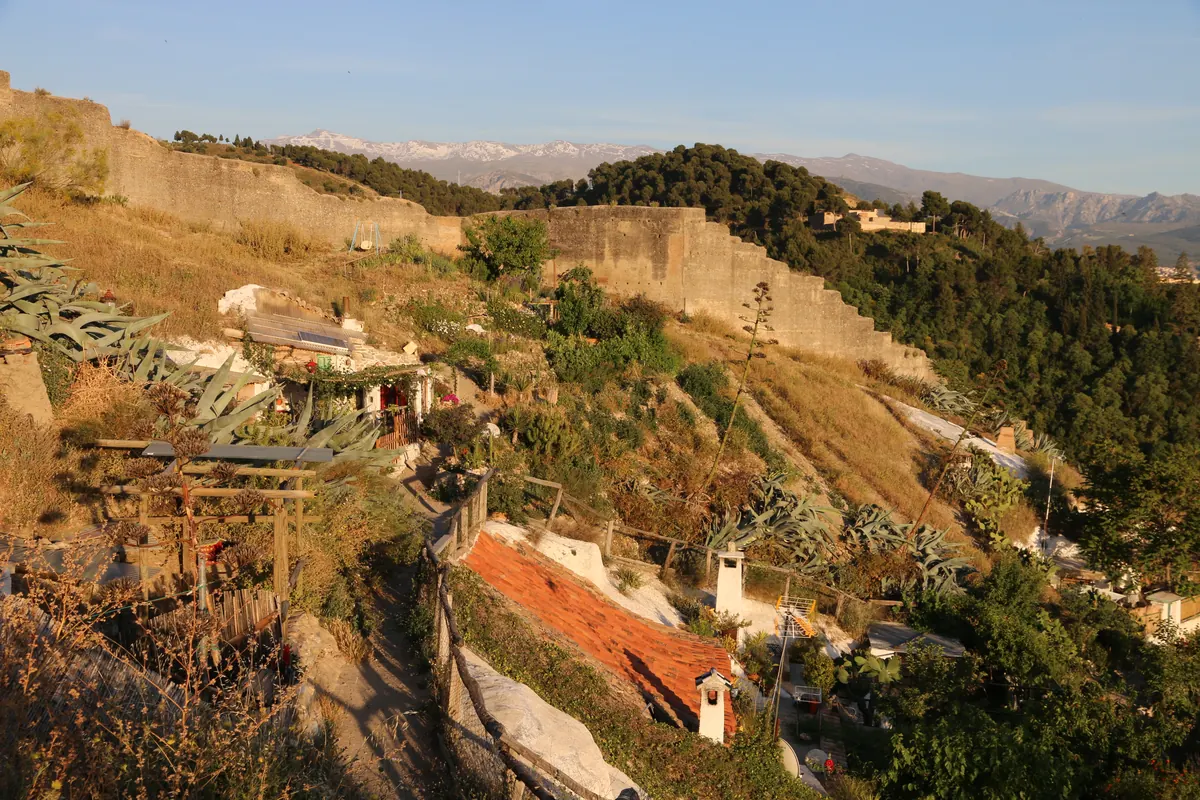
Wikipedia describes Sacromonte as a traditional neighbourhood in the eastern area of Granada, on a hillside opposite the Alhambra. Its homes are the caves that give it its character. The same article says their origin is not very clear and assumes that building began in the 16th century, after the expulsions of Jews and Muslims, with caves housing marginalised people outside the city walls.
How a cave is made
Spanish Wikipedia says many hollows formed naturally through erosion in the Quaternary period. A home began by clearing the face of the hill where the cave was to be dug. A round arch served as the door, and the rooms were dug out behind it. The Sacromonte Caves Museum recreates such rooms, among them a kitchen, a stable and a forge. Interiors were whitewashed with lime. The article adds that the caves were valued for their thermal conditions and for the safety they gave as shelter or housing.
Who lived here
Wikipedia says Sacromonte is traditionally associated with Granada's Romani community, who settled there after the Christian conquest of 1492. Spanish Wikipedia calls the hillside the place where Granada's lower class lived, and lists blacksmiths, peddlers, farmers, craftspeople and flamenco artists among the residents. The Sacromonte Caves Museum presents the roots and culture of the Roma people as closely tied to the neighbourhood, and its themed caves, among them basketwork, pottery, looms and a forge, show some of the trades that sustained daily life there.
A cradle of Granada flamenco
Spanish Wikipedia calls Sacromonte the cradle of Granada flamenco, where zambras arose in tablaos inside the cave houses themselves. English Wikipedia names the singer Curro Albaicín as born in Sacromonte into a flamenco family. Wikipedia says zambra is today mostly performed in the Sacromonte caves, and one of the museum's caves is given over to the neighbourhood's flamenco history.
Read next: What is zambra flamenco?
The floods of 1963
Spanish Wikipedia records that strong storms and floods ended up burying most of the caves, and that residents who were affected were evicted, many of them never returning. Andalucía's tourist board adds that Romani families still live in the caves and hold zambras in private. Wikipedia adds that the Darro valley has been a Site of Cultural Interest since 2016, a Spanish designation rather than a UNESCO one.
Seeing the caves as museum rooms
The Sacromonte Caves Museum opened in 2002, according to Wikipedia, and occupies 4,800 square metres. Its own site describes eleven original caves that recreate trades and daily life, including a dwelling, a flamenco cave, a stable, basketwork, a kitchen and a forge, plus a lookout with views of the Alhambra. A visit by day shows what the cave rooms were like to live in, before an evening zambra shows what they became.
Read next: Getting to the Sacromonte caves
The abbey above the caves
Wikipedia says the Abbey of Sacromonte was built by Archbishop Pedro de Castro in the 17th century, and that its supposed relics and the Lead Books were forgeries. Its library, which holds incunabula and manuscripts, is currently closed. It stands in the same neighbourhood as the caves, and a visit to it fits naturally into a day on the hill.
Frequently asked questions
When were the Sacromonte caves dug?
Their origin is not very clear. Wikipedia assumes building began in the 16th century.
Do people still live in Sacromonte's caves?
Yes, some Romani families still live in caves, according to Andalucía's tourist board.
What happened in 1963?
Spanish Wikipedia says storms and floods buried most of the caves and many families never returned.
Sources